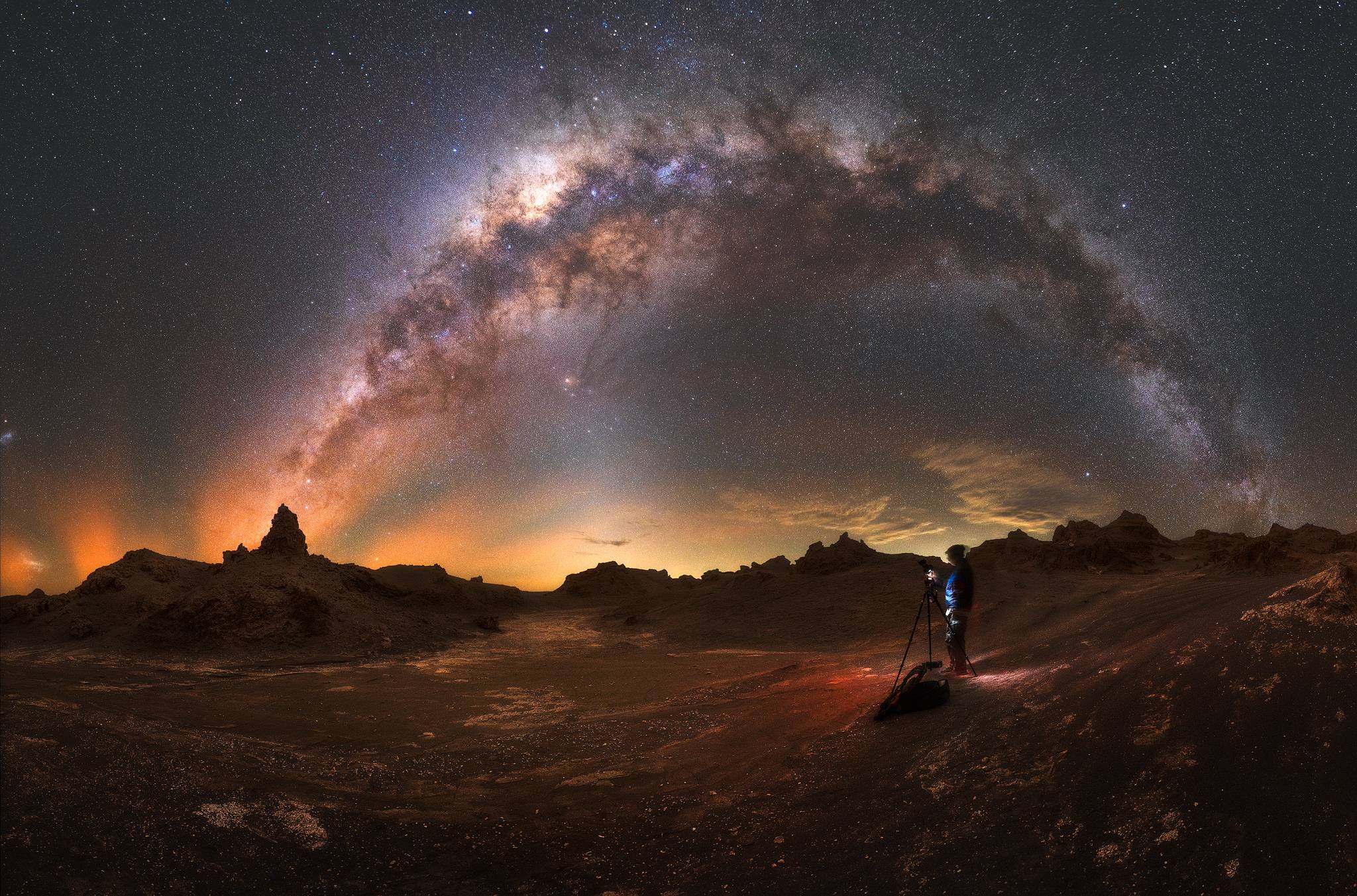
By Alexis Trigo – Photographer based in San Pedro de Atacama
The Atacama Desert is, without question, one of the best places in the world to photograph the night sky. Low humidity, very little light pollution and more than 300 clear nights a year make it a paradise for any photographer who wants to capture the Milky Way. But not every spot in the desert is equally easy to reach.
After nine years living and photographing in San Pedro de Atacama, I have explored dozens of places at night, looking for that great composition that moves me. These are, in my opinion, the five places with the best conditions for landscape astrophotography — ranked from greatest to least photographic impact.
1. Rainbow Valley — The gem of photographic composition
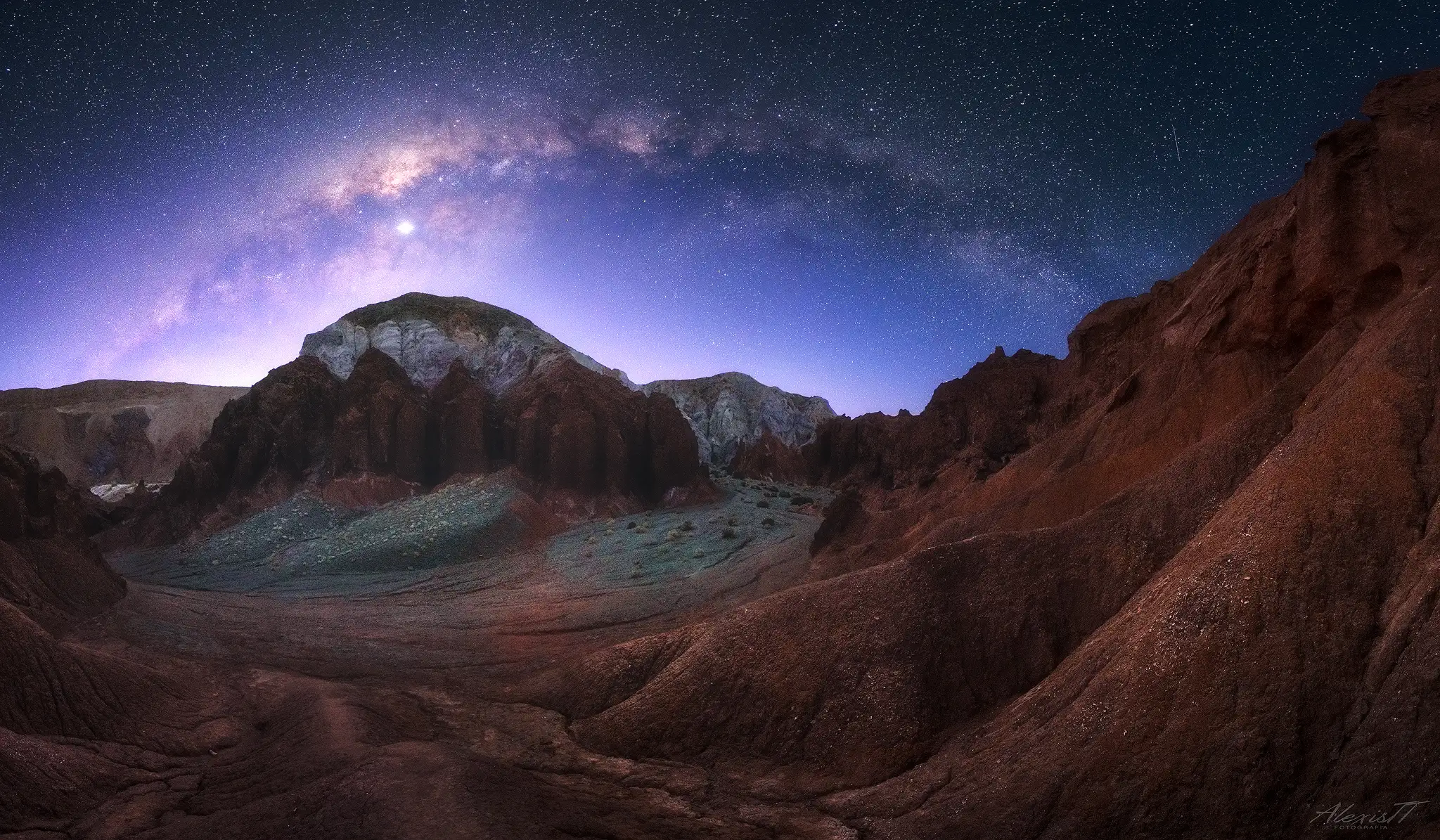
If I had to choose just one place in San Pedro de Atacama to photograph the night sky, it would be Rainbow Valley. Its multicolored rock formations — the result of minerals in the Cordillera de Domeyko — create a truly unique foreground that, in my opinion, no other place in the desert can match.
What surprises me most every time I go back is how many composition options it offers. Move just a few meters and you have a completely different view — another formation, another angle, another relationship between ground and sky. You can spend hours exploring and every frame has something new to offer.
Because it is surrounded by rock formations, the horizon is not fully open, but far from being a problem, that is an advantage: the rocks act as a natural barrier that blocks the faint light pollution coming from Calama. The result is an extraordinarily dark sky. On the Bortle scale this place is rated Class 2 — but in my personal experience, for landscape astrophotography it behaves like Class 1. It is one of the cleanest skies I have photographed in nine years.
At night, the reddish, green and yellow tones of the rocks contrast with the deep blue of the starry sky, creating compositions that need no heavy processing to be striking.
What makes it special: the mineral colors on the ground pair beautifully with the colors of the night airglow, and the landscape formations are hard to beat for composition. The variety of frames available within a small radius also makes it ideal for groups.
Best time: April to September, when the Sagittarius Arm is well placed and the nights are longer. The summer sky (Orion) is also interesting, so don’t rule it out!
2. Vallecito — The perfect place to practice
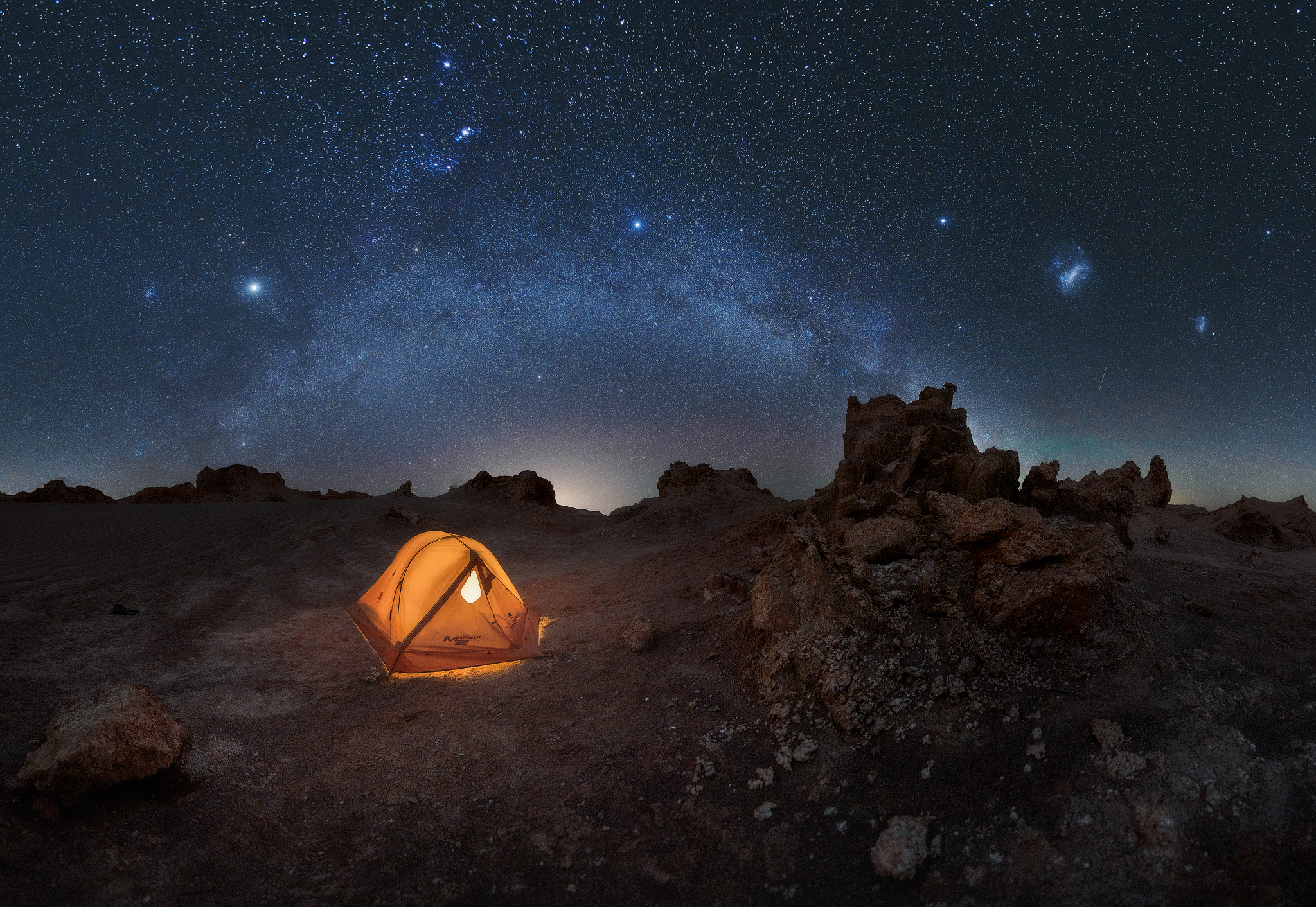
Vallecito holds a very special place in my expeditions: it is always the first place I visit with any group. Always. Whatever your experience level, whatever the season — Vallecito is the essential starting point for any photographer who wants to learn landscape astrophotography in San Pedro de Atacama.
Why? Because this wide area, full of rock formations of every shape and size, is the ideal place to explore angles, practice techniques and find your own style without the pressure of a more demanding location. There is plenty of room to move around, access is good and the formations offer endless foreground options. It is also extremely safe.
This is also home to the famous Magic Bus — an abandoned bus in the middle of the desert that has become one of the icons of landscape astrophotography in San Pedro. Photographing it under the Milky Way has become a classic no photographer wants to miss.
What makes it special: the variety of elements and room to compose is endless, and the size of the area lets groups work without getting in each other’s way. You always find something new, no matter how many times you have been there.
Best time: All year. Personally, my favorite months are April to September, when the nights are longer and the Milky Way is in a prime position.
3. Baltinache Lagoons — The mirror of the sky
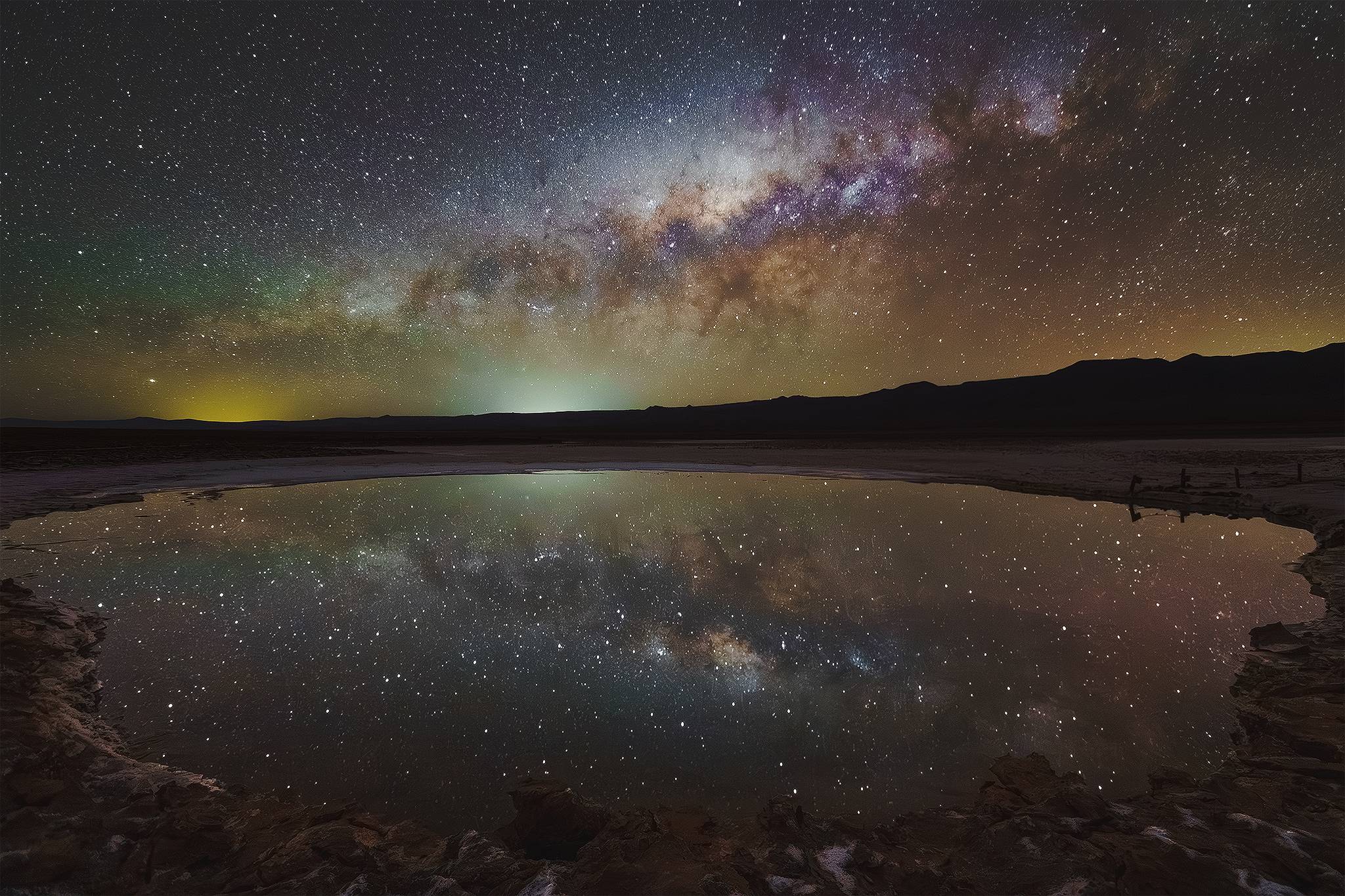
The Baltinache Lagoons offer one of the most sought-after effects in landscape astrophotography: a perfect reflection of the night sky on the water. What makes them special compared to other lagoons is how close you can get to the water’s edge — sometimes just a few centimeters — which allows extremely sharp reflections and very clean compositions.
You can shoot here in both halves of the year, but the second half is clearly the best. At that time, the last lagoon — the farthest and largest — is where the reflection works best, mainly because the Milky Way shifts west and is mirrored directly on it.
Besides the sky reflection, there is another element few photographers know about: a floor of hexagonal salt formations around some of the lagoons. It makes a very interesting foreground that, combined with the reflected sky, produces images on another level.
Critical factor — wind: If the night is windy, forget the reflection. The water ripples and the image is completely lost. Always check the wind forecast before heading out. A night with a perfect sky but strong wind at Baltinache is a wasted outing.
A fragile ecosystem — treat it like a natural laboratory: The Baltinache Lagoons are more than a photogenic landscape — they are an ecosystem of unique scientific value. Their hypersaline waters (~220 g/l) host communities of extremophile bacteria and possible stromatolites, microbial formations thousands of years old that are extremely fragile to human contact. Walk only on the marked trail, never on the salt crusts or near shores that are not open to visitors. This place exists because the Coyo community looks after it. Please do the same.
Permit required: To enter at night you must request permission from the Coyo community. It has to be arranged well in advance and must be respected.
What makes it special: the high-resolution reflection, the hexagonal salt floor and how close you can get to each lagoon create truly striking compositions.
Best time: August to November, when the Milky Way points west and the last lagoons offer the best reflection.
4. Monjes de la Pacana — The sharpest sky you will ever see
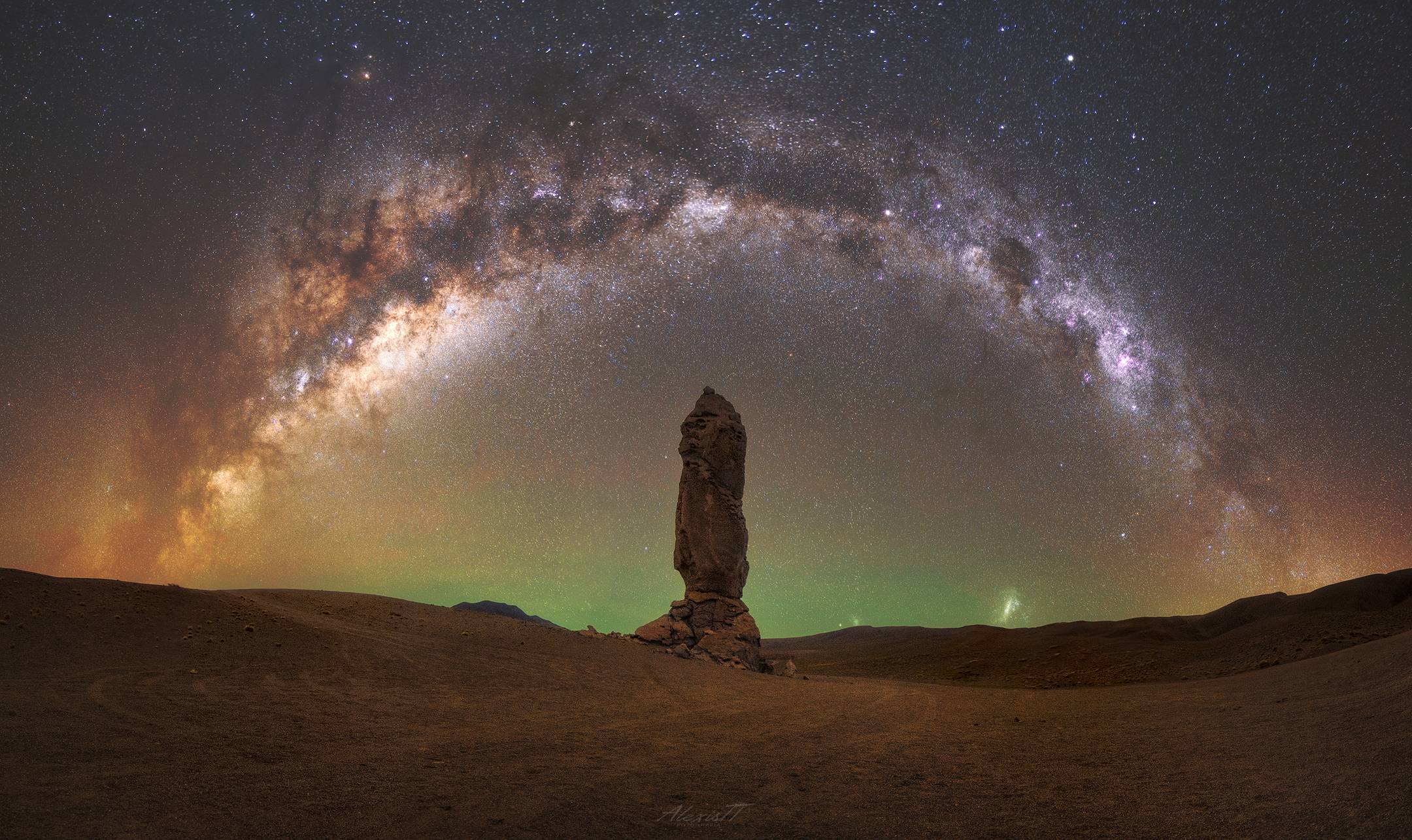
If you want to experience the purest night sky in the Atacama Desert, the high Andes are the place, and the Monjes de la Pacana in particular. At more than 4,500 meters above sea level, this place has Class 1 skies on the Bortle scale — the darkest rating there is. Put simply: you will see more stars than you thought existed.
The rock formations, with the imposing Gran Monje de la Pacana as the star, offer an otherworldly foreground. The combination of that extremely sharp sky with the volcanic formations of the Altiplano produces images that are among the best I have captured in nine years of night photography.
Precautions to take very seriously:
- Temperatures can drop to -18 °C in winter and spring. In summer and autumn the lows are around -6 °C. Warm gear is absolutely essential.
- There is no internet or mobile signal anywhere in the area.
- If you have a satellite phone, bring it.
- Always notify the Carabineros (police) before leaving, letting them know you are going there at night.
- Check the weather well in advance. If rain, snow or thunderstorms are forecast, do not go under any circumstances. On the Altiplano conditions can change quickly and become very dangerous.
- I recommend always going with someone, never alone.
What makes it special: the quality of the Altiplano sky is simply unbeatable — you could even walk without a headlamp and see the sky lighting up the landscape. For the purest contemplation of the night sky, this is the place.
Best time: Because of the temperatures, I recommend summer and autumn (December to April), when the lows are less extreme. But be careful! Remember to check the weather well in advance: the summer months bring the Altiplanic winter, and February is the month most prone to bad weather.
5. Guatín Canyon — Giant cacti, a waterfall and silky water
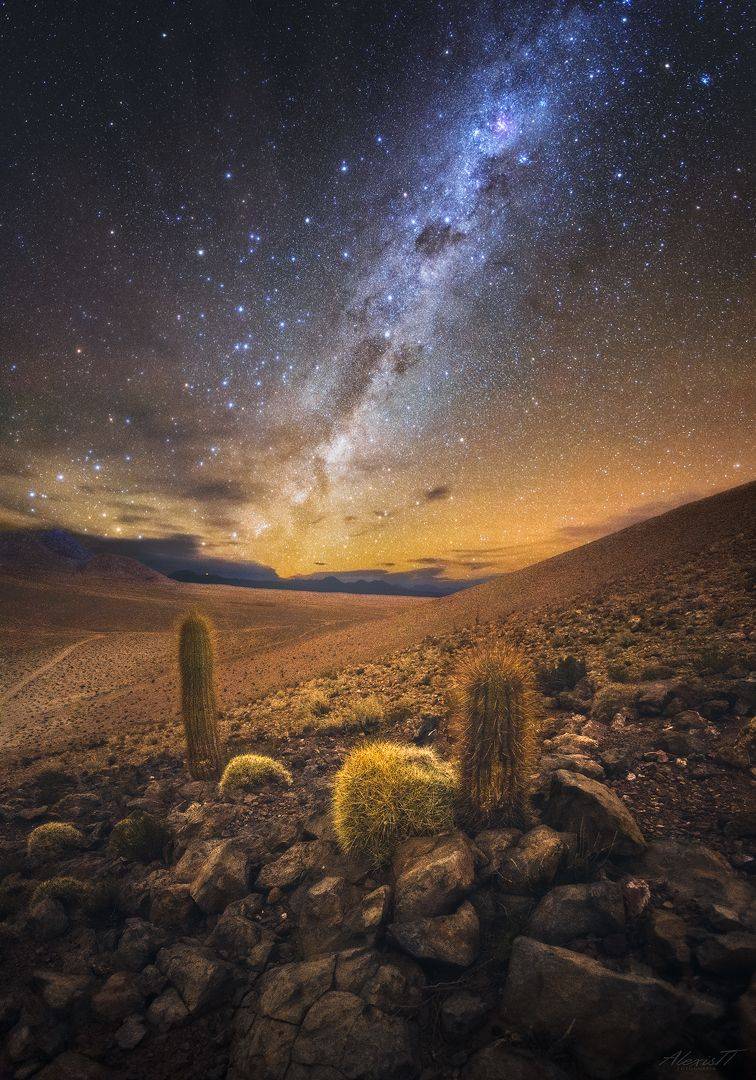
Guatín Canyon is one of the most unusual places for landscape astrophotography around San Pedro de Atacama. Unlike the desert’s wide open spaces, the protagonist here is not a broad horizon but an intimate, vertical scene: giant cacti reaching up into the night sky, a small stream that turns into a silky veil with long exposures, and a little waterfall that adds movement and texture to the composition.
Because it sits inside a narrow canyon, the visible horizon is limited — and you need to take that into account. The key is patience: you have to wait for the galactic core to rise high enough to appear above the canyon walls. Once it does, the compositions you can create are completely different from anything else in San Pedro.
The ground is almost entirely rocky, so walk carefully, especially at night. No permit is needed to enter.
What makes it special: the combination of giant cacti, the silky stream and the small waterfall offers a kind of night photography completely different from the other places on this list — more intimate and more vertical.
Best time: May onward, when the galactic core is high enough above the horizon to clear the canyon walls.
General tips for night photography in San Pedro de Atacama
Whichever place you choose, these tips will help you make the most of your night out:
- Plan around the Moon: the best nights are around the new Moon and the middle of the waning cycle. Check the lunar calendar before confirming your dates.
- Arrive before dark: you need time to explore the terrain in daylight and set up your frames before it gets completely dark.
- Always dress warmer than you think you need: even in summer, desert nights are cold. On the Altiplano, the cold can be extreme.
- Charge your batteries: the cold drains batteries much faster than usual. Always carry spares.
- Use a red headlamp: red light does not ruin your dark-adapted night vision the way white light does.
- Always check the weather: especially on the Altiplano, conditions can change fast. A good night in town does not guarantee good conditions at altitude.
Other places worth exploring
Beyond the five main places on this list, there are other corners of San Pedro de Atacama that offer interesting night experiences for the adventurous photographer:
- Laguna Lejía: One of the best reflections in San Pedro de Atacama, facing north, which lets you compose with Sagittarius or Orion depending on the season. Night access requires permission from the Talabre community, which makes it less accessible, but it is well worth trying. Take the same precautions as at La Pacana.
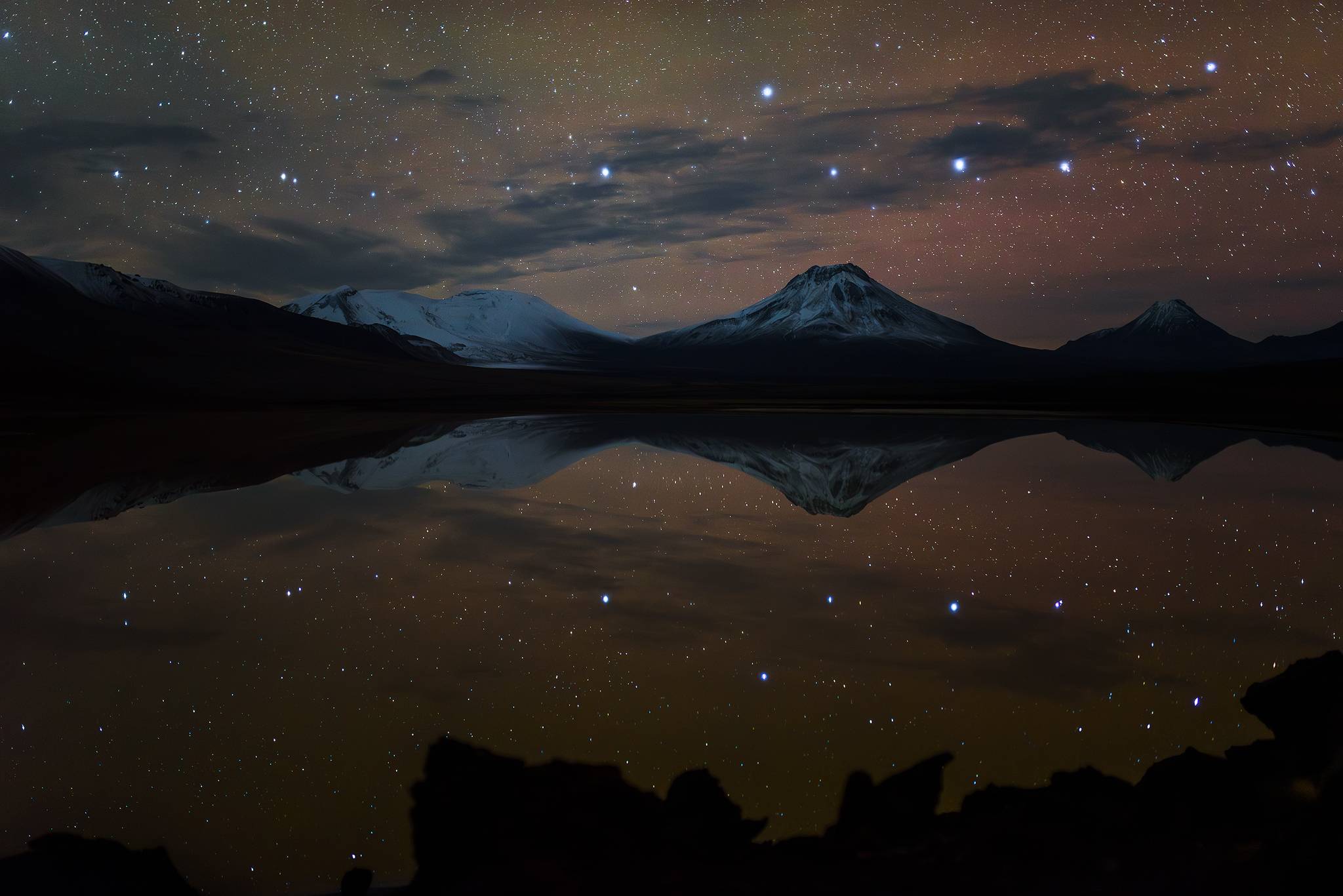
- Aguas Calientes Viewpoint: Class 1 sky on the Bortle scale — one of the sharpest in the whole area. Its main drawback is distance: it is a long way from San Pedro de Atacama (154 km), which makes it a more demanding expedition logistically. Take the same precautions as at La Pacana.
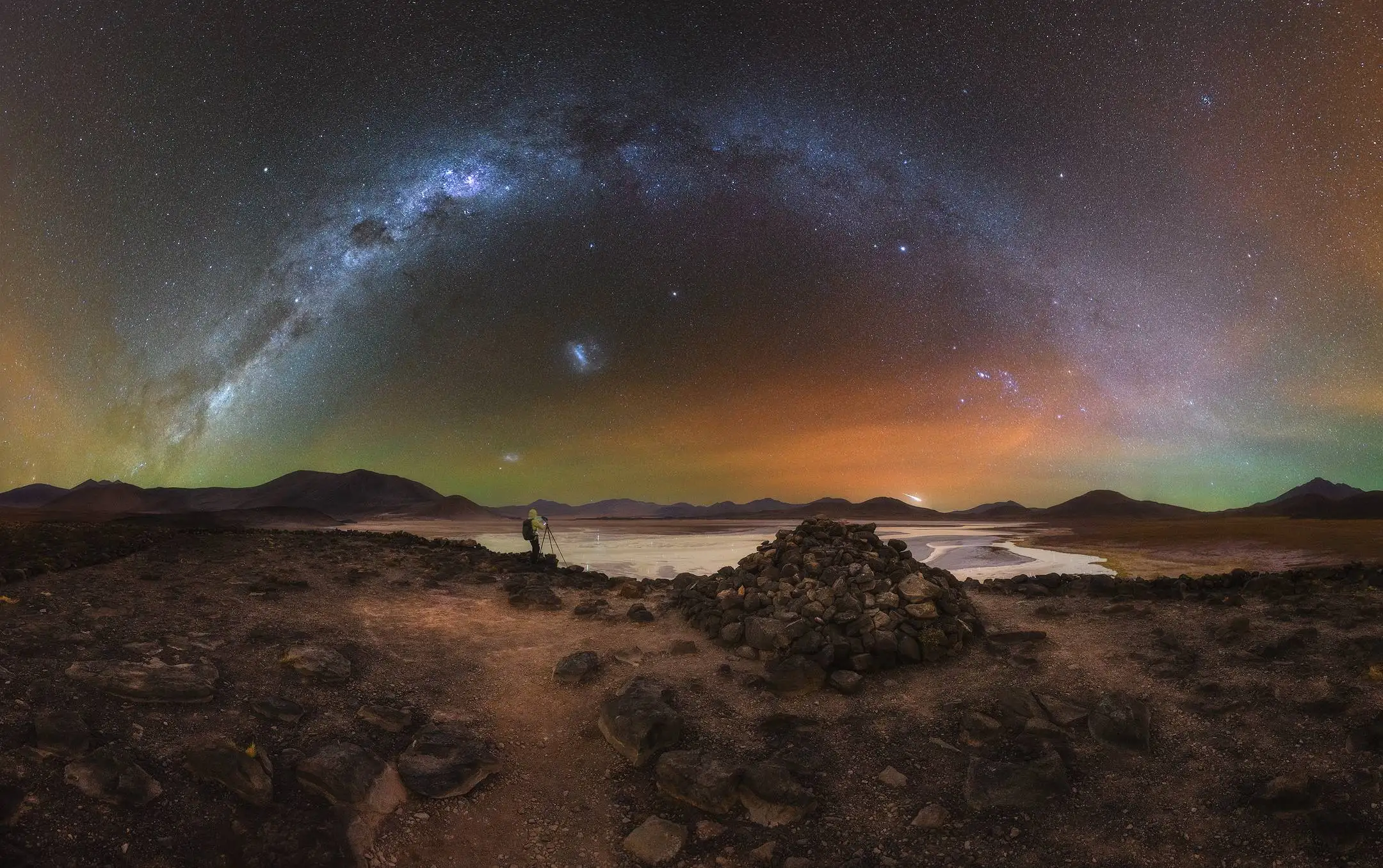
Want to photograph these places with an expert guide?
If you would rather live this experience with professional guidance, on my Astrophotography Expeditions in San Pedro de Atacama we visit several of these places in a program of 4 shooting nights plus a welcome night, designed for photographers of every level. Groups of up to 6 people, access to exclusive locations and an editing master class included.
Alexis Trigo is a photographer based in San Pedro de Atacama, published by National Geographic and twice selected as NASA’s Astronomy Picture of the Day. He leads night photography expeditions in San Pedro, Patagonia, Araucanía and Uyuni.